Alexa Lane - Christian Arts and Wellness
Content Creator
HOW TO CREATE YOUR BEST ACTOR SELF–TAPE

Actor self-tape – Create your best impression
Congratulations! You have submitted yourself for a project or your agent did and the casting director is interested in meeting you! Your next step is to submit your actor self-tape! For the beginners out there, below are few ideas to improve your self-taped auditions.
Script analysis:
It’s important to know as much about your character and the plot. Thoroughly read the character breakdown and sides or full script if it’s available. Determine the arc of the story for your character and the arc of the individual scene. For shows that are currently airing, watch a few episodes to get a feel for the show. Once you have a better understanding of the project, refer to our blog on Script Analysis to further refine your choices.
If your scene includes speaking to multiple characters, make sure you have a specific place and eye line for each character.
Memorize your lines:
We realize sometimes you do not have enough time to memorize multiple pages, but if possible, try to be off book. Obviously, having your lines memorized allows you to be more relaxed and prepared.
Appearance:
Present yourself in the best possible way. In general, a natural makeup and hair look for woman. Yes, you guys may need a little foundation to even out your skin tone for the camera.
Of course, you want to look like the character you are auditioning for. This does not mean you need to dress in costume, but wear something that makes sense for the scene and gives the essence of the character.
Lighting:
Casting directors
need to see you clearly. A properly lit acting self-tape can also add to the
professionalism of the end product. In addition it conveys to the viewer a
sense that you are a serious actor committed to your craft. By going to a professional self-taping video
establishment you can benefit from multiple lighting sources which presents the
actor in an attractive three dimensional look.
If you choose to create your own acting self-tape at home you can purchase all-in-one lighting kits that, while not ideal, is a definite upgrade over general room lighting. Here is a link to B&H Photo, an excellent online photo and video resource, of a kit that includes a light, stand, cell phone holder and accessories for less than $70
Background:
Choose a solid color background. Grey looks great on all skin tones.
Stay away
from patterns as they are distracting and draw attention away from you.
If you are shooting at home you can also shoot against a plain painted wall.
You can also invest in inexpensive backdrops; either paper or fabric.
Sound:
Casting Directors also need to hear you. Similar to lighting, sound is equally important to the overall quality of your actor self-tape. Professional studios usually offer high end microphones placed on boom stands to ensure that your lines are clear and loud enough. A great vocal recording enhances the overall self-tape and will draw the viewer into your video and performance.
Creating a self-tape at home with a phone is a typical choice. If you have editing capabilities to improve the video quality and enhance the audio your end product can be quite adequate. Remember that audio coming from a cell phone can often be very low quality to the small, digital internal microphone. Another home option is to use a separate audio recorder placed alongside your phone/camera. You will need to import the separate audio with some editing software. Adobe Premiere Elements involves somewhat of a learning curve but is inexpensive and allows you to improve both the video and audio elements of your self-tape:
B&H Photo – Adobe Premier
B&H Photo – Zoom Recorder H4n
Doing self-tape production yourself is a definite option however it does involve an initial investment, learning curve, and will likely produce a good product but not to the level of a professional studio.
Slate
Slating is often uncomfortable. Try to think about it as if you are introducing yourself to a new person. Smile; say your name and any other details that were specified. Relax! Be pleasant! Be yourself!
We hope that helps!
Audition Preparation Tips

Audition Preparation and Script Analysis
Breaking down a script for a project or an audition can be a daunting task for beginners. It requires refining your acting technique in order to create realistic characters and to serve the story you are telling.
To get started, it’s a good idea to answer a few simple questions, listed below, that will help you discover the truth behind the words and create full, rich moments.
Truly knowing what your characters are talking about and why your characters need to do what they are doing will bring urgency, life, and reality to the scene. Each moment and choice must be specific. Give this process 100% of your energy and you will uncover clear and unique choices.
Once you have broken down your script and are ready to rehearse with other actors, be sure to stay present and open, moment by moment, and actively listen to the other actors. Truthfully connecting to other actors in the scene is the key to organic authentic human behavior.
Audition Preparation & Script Analysis I: Begin by answering these questions:
- Who – Who is the character? What are their beliefs, philosophy, and career? You are going to use your voice, body, and truth to discover and create each character you play.
- What – What is going on in the scene? What are the circumstances? What does your character want? What is your character doing?
- Where – Where is the scene taking place? Be very specific about the place that the scene occurs. What are your surroundings?
- When – When is the scene happening?
- Why – Why is your character performing the actions in the scene?
Audition Preparation & Script Analysis II: Add more specificity by integrating the following:
- Overall Objective/Needs/Desires– The overall objective has to do with what the character wants and needs in life. Their deepest desires.
- Scene Objective- The scene objective has to do with what the character wants in the scene.
- Actions/Intentions/Goals- The action steps the character takes to get what they want.
- Unit- A unit is a large segment of the script that may contain smaller “beats.” Units change when a major action happens in the story.
- Beat– A beat is a smaller action or thought that changes when new thoughts or actions arise.
- Emotional Life- The emotions the character feels throughout each scene.
- Moment Before– The events that just happened before the scene starts.
- Activities– Activities involve handling props or doing things like getting dressed, tying your shoes, eating, playing a game.
- Commit to Activities– You must really do any activity your character is engaged in.
- Present Moment Awareness– Always stay connected to the present moment. Truly listen “moment to moment.”
- Use all of your senses– Acting demands that you use your total body and senses to stay present. That means, see, feel, hear, smell, taste.
- Stay true and spontaneous– Acting requires the actor to be open to every emotion and feeling that spontaneously comes up in a scene. Be available to your acting partners.
- Obstacles– Internal and external blocks that get in the way of the character’s ability to accomplish their needs or desires.
- Back Story– The back story is the character’s personal history built by the key facts and phases in the script.
For tips on actor self-taping best practices see our recent Blog Post
Benefit of Children’s Theatre
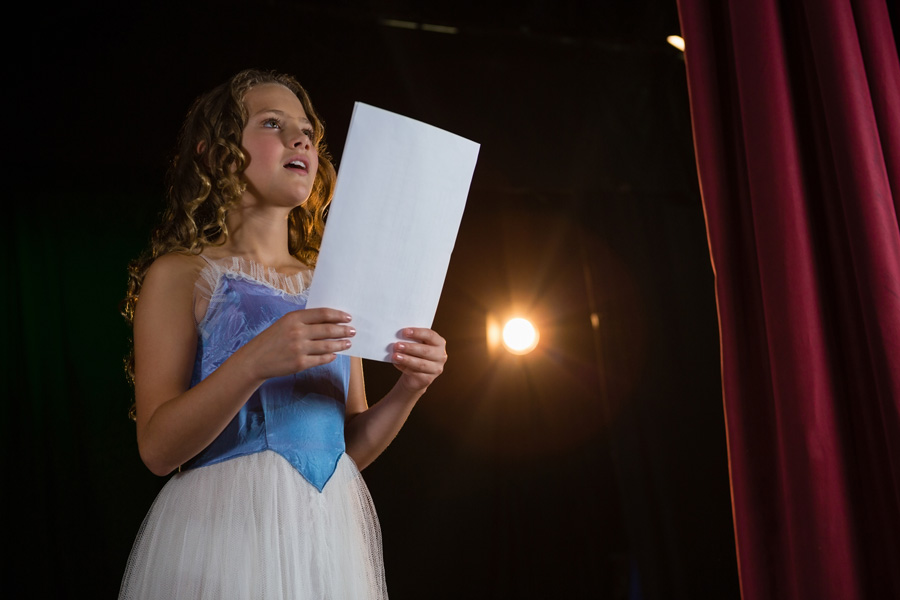
Our Children’s Theatre Program prepares students with the skills needed to either enter college as a theatre major or pursue a career as a professional singer, dancer, and actor. The program focuses on the fundamental aspects of theatre including music, learning dialogue and lyrics, dance, set design, costumes, and props.
Students will learn contemporary vocal techniques to build their vocal skills safely. A solid acting technique is taught that will help young actors break down a script and deliver a truthful, organic performance. Dance terminology and choreography, movement skills, and relaxation techniques are taught in each class to equip young musical theatre performers with the strength to move with grace and ease.
What are some of the benefits of children’s theatre program?
Professional Development
In the current theatre market, children are expected to be prepared for their auditions. This means memorizing their lines, making clear acting choices, and having polished songs to sing for auditions. This is why training is so important. Taking the time to study acting and voice will help your child have the skills to audition for the school play or enter college as a theatre major.
Personal Enrichment
Numerous studies have been written on how arts education can enrich a child’s life. Specifically, studying theatre can help children have the confidence to express themselves and is a great tool for social/emotional learning.
Through the process of storytelling, children learn to connect to their emotions and to be empathetic towards others. These skills translate into children becoming powerful public speakers and leaders. Theatre classes can also help with creative thinking and problem solving.
Whether your child participates in a theatre class for enrichment or professional development, your child will have fun being a part of a Musical Production or Play. They will share the experience of telling stories through songs, dance, and dialogue with other children and grow from the experience. I have taught many children over the years and have seen lifelong friendships develop that started in a performing arts class and the positive impact the arts have had on young lives.
Barre Class

Thinking about trying a barre class, but are worried that you have no dance experience?
It’s true that some of the exercises in the class are inspired and drawn from ballet and jazz dance; however, you do not need to be a dancer to enjoy barre classes. One of the many benefits of a barre class is that the class offers a total body workout in less than an hour.
Cardiovascular Fitness
The barre classes that I teach begin with easy to follow cardio dance. I work with light hand weights during the cardio section to tone the upper body.
Muscular strength and endurance
After the cardio section, strengthening exercises are performed at the barre or center floor. Here you will you will find ballet leg positions and exercises that may be performed in, lateral rotation, “turn out” or parallel. Working in lateral rotation will tone up your gluteal muscles and thighs and target muscles that may be missed in traditional weight training. The barre exercises are performed using multiple repetitions to train muscular endurance and sculpt a long, lean body. Core stability exercises utilizing resistance bands are performed on the mat or standing to sculpt further and strengthen your entire body. You will most likely feel a burn and may be sore after your class, but these exercises will not bulk you up.
Flexibility
Barre classes take the body through a full range of motion and will help increase your overall flexibility. Dynamic flexibility exercises are used throughout the class, particularly in the warm-up. Due to a thorough warm-up and muscle work, your body is better prepared for the end of class stretches.
Weight Loss
Barre classes can help you lose weight and promote lean muscle gains. The cardio component will help burn calories and the muscle work will build lean muscles creating a slender figure. Barre classes can help increase your metabolic rate due to the fact that they are a comprehensive exercise class.
Positive Psychology
Exercise has been shown to reduce feelings of depression, particularly aerobic exercise and resistance training. Barre classes not only give you a great physical workout, but are also upbeat and fun contributing to an overall positive mental state.
With all the benefits above, it’s easy to see why a well-designed barre class provides cardiorespiratory fitness, muscular fitness, flexibility, body composition, and neuromotor fitness covering all the components of physical fitness.